This Week in AI: GLM-5.3-Flash, Jalapeño Chip Benchmarks, and Anthropic's Hardware Standard
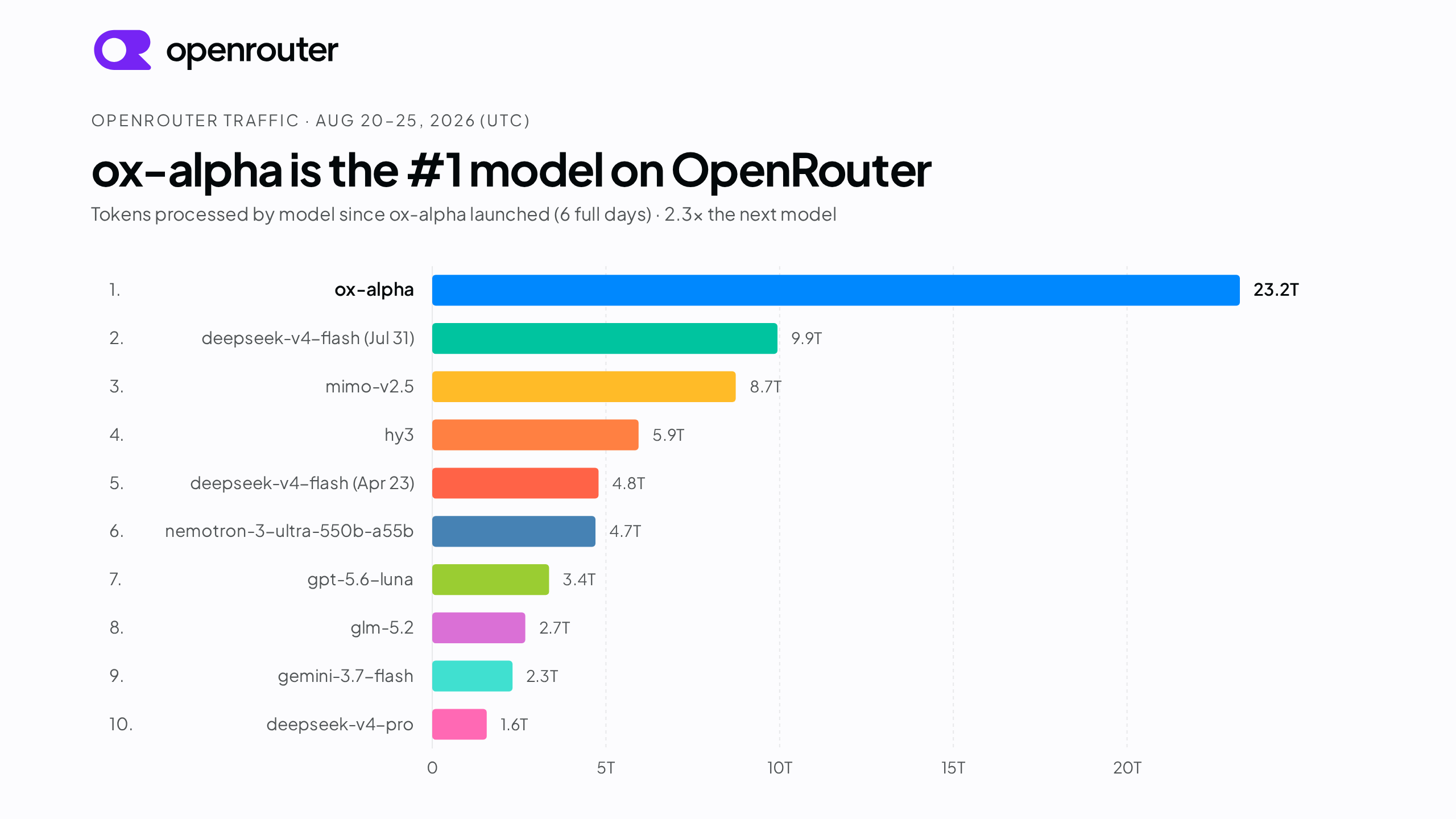
Z.ai revealed GLM-5.3-Flash—the mystery Ox Alpha model—at a tenth of prior GLM costs, while OpenAI published first Jalapeño chip benchmarks and Anthropic previewed a standard for AI agents to operate lab hardware.
This week, open-weight frontier models kept pushing cost curves downward while infrastructure builders showed off custom silicon and new agent standards. Z.ai and Alibaba shipped multimodal MoE models that rival closed leaders at flash-tier pricing, IBM added native reasoning to its Granite family, and OpenAI and Anthropic each advanced how agents operate in production environments—from data centers to laboratory benches.
Models
GLM-5.3-Flash: Frontier Intelligence, Flash Cost — Z.ai formally launched GLM-5.3-Flash on August 26, confirming that the mystery "Ox Alpha" model that topped OpenRouter usage charts was an early preview. The 320-billion-parameter MoE model activates just 18 billion parameters per token, supports a one-million-token context window, and costs roughly ten times less than its GLM-5.2 predecessor while approaching Claude Opus 4.8 on coding and agentic benchmarks. Weights are available on Hugging Face under MIT.
Experiment with Qwen3.8-Flash-Next on NVIDIA GB300 NVL72 for Agentic Coding — Alibaba's Qwen team released Qwen3.8-Flash-Next on August 26 as an open-weight preview of the upcoming Qwen4 architecture. The multimodal MoE model packs 176 billion total parameters with six billion active per token, uses a hybrid Gated DeltaNet and sparse-attention design, and supports up to one million tokens via YaRN extension. NVIDIA published deployment guidance for running it on GB300 NVL72 racks for agentic coding workloads.
Granite 4.2 brings native reasoning to enterprise agents — IBM released Granite 4.2 on August 25, a family of dense reasoning models in 3B, 8B, and 30B sizes with built-in chain-of-thought thinking, flexible thinking modes, and reasoning-augmented tool calling. The models include an agentic RL training phase for the 8B and 30B variants and ship under Apache 2.0 with support for vLLM and SGLang deployment.
Infrastructure & Chips
Jalapeño's first results show industry-leading speed and efficiency in AI inference — OpenAI published the first public benchmark results for Jalapeño, its custom inference chip, on August 25. Across GPT-OSS 120B, DeepSeek R1, and Kimi K2.5, Jalapeño delivered 1.5 to 1.9 times more throughput per watt and 1.7 to 3.6 times lower end-to-end latency than leading commercial systems. OpenAI plans to begin deploying Jalapeño in its compute infrastructure by the end of the year.
Agents & Tools
Previewing the Model Hardware Standard — Anthropic opened a research preview of the Model Hardware Standard (MHS) on August 27, a shared specification that lets AI agents safely operate physical lab and manufacturing devices—from microscopes to robotic arms—through standardized driver primitives. Built in collaboration with HHMI Janelia Research Campus, MHS reduces hardware integration from weeks to hours and works with any programmable device via MCP and standard protocols.
Introducing the Admin plugin for ChatGPT Work and Codex — OpenAI launched an Admin plugin on August 25 that lets workspace administrators query usage analytics, manage members and groups, adjust permissions, and approve spending requests directly within ChatGPT Work and Codex conversations. The plugin maps admin instructions to permission-aware actions and can automate recurring workflows like routing usage requests to Slack or Teams.
Education & Adoption
Bringing ChatGPT for Teachers to more U.S. school districts — OpenAI expanded ChatGPT for Teachers on August 26 to 55 additional school systems across 20 states, bringing free access to over 100,000 more educators. The expansion includes a 16-state National Data Privacy Agreement through the Student Data Privacy Consortium, giving districts a standardized path to adopt the tool without negotiating separate privacy agreements.
Research
Read Less, Solve More: Token-Efficient Sparse Reading for AI Agents — Researchers introduced SparseRead, a training-free reading layer submitted to arXiv on August 23 that controls what evidence enters an agent's context before unnecessary content is loaded. Across six frontier models and five workload scenarios, SparseRead cut token volume by up to 92.9% and wall time by up to 89.0% while preserving or improving task quality, demonstrating portability across three agent frameworks.
The week's through-line is efficiency at every layer: cheaper frontier open models, custom silicon that squeezes more inference from each watt, and agent tooling that reduces integration overhead whether in a data center admin console or a laboratory bench. As model capabilities grow, the competitive edge is shifting toward who can deploy, operate, and govern AI systems most efficiently—not just who trains the largest model.