The Main AI Model Architectures Explained
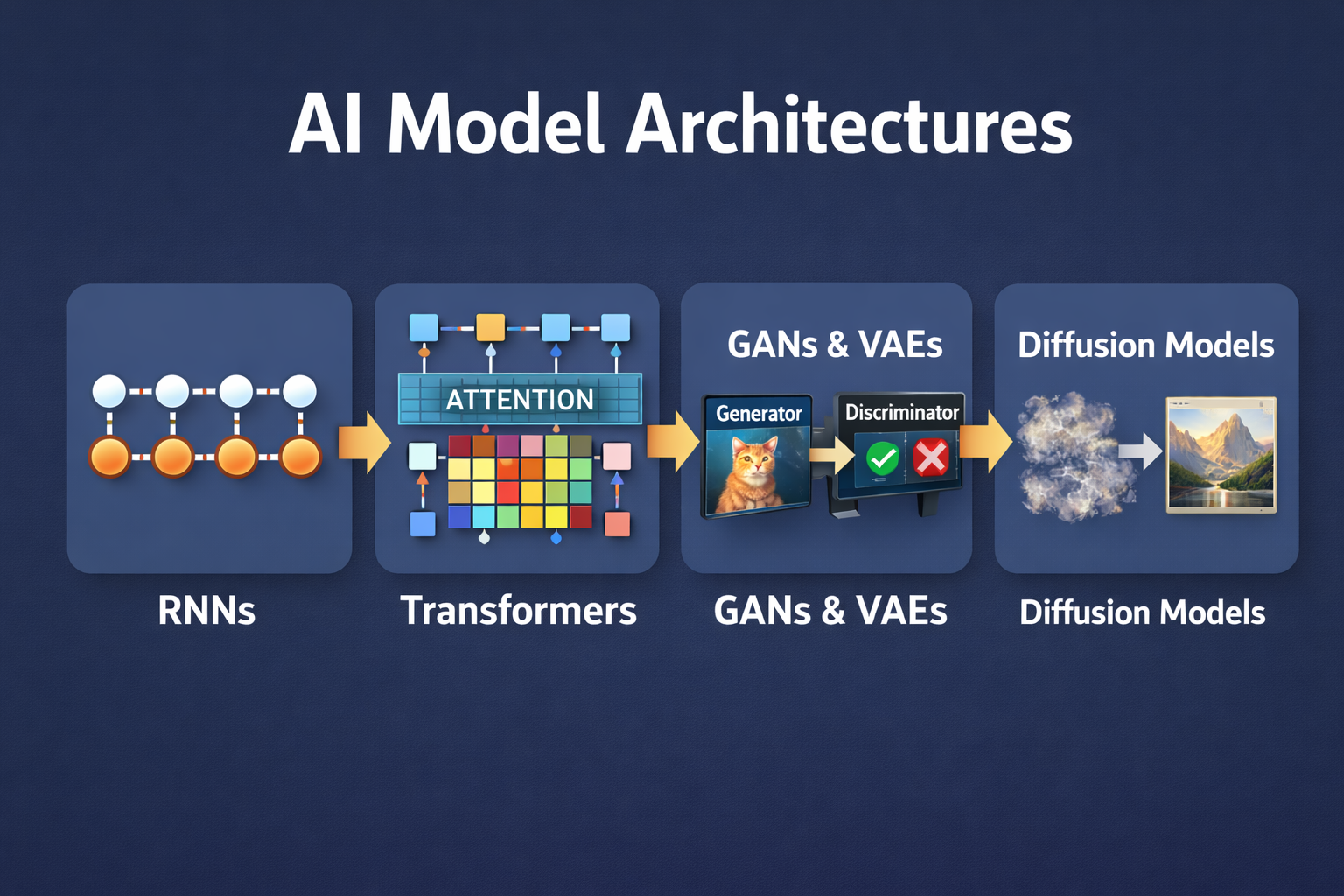
A simple overview of the main AI model architectures, including RNNs, Transformers, GANs, VAEs, and diffusion models, and how they power modern AI systems.
Artificial Intelligence has evolved through different neural network architectures.
Each one was designed to solve specific problems such as language understanding, image generation, or sequence prediction.
Understanding these architectures helps developers see why modern AI works the way it does and why models like ChatGPT are built the way they are.
Below are some of the most important architectures in modern AI.
Recurrent Neural Networks (RNN)
Recurrent Neural Networks were one of the earliest architectures designed to work with sequential data.
They process information step by step and keep a hidden state that carries information from previous inputs. This makes them useful for tasks where order matters, such as:
language modeling
speech recognition
time series prediction
However, RNNs struggle to remember information from long sequences. This limitation made them difficult to scale for complex language tasks.
Because of this, newer architectures eventually replaced them in most modern AI systems.
Transformers
Transformers are the architecture behind most modern AI systems, including Large Language Models (LLMs).
Unlike RNNs, Transformers process all tokens in a sequence in parallel using a mechanism called self-attention.
Self-attention allows the model to evaluate how each word relates to every other word in a sentence. This makes it much better at understanding context and long-range dependencies.
Transformers are now used for many tasks including:
chatbots and language models
code generation
translation
document understanding
Most modern AI tools, including GPT models, are built on this architecture.
Generative Adversarial Networks (GANs)
GANs are designed for generative tasks, especially image generation.
They consist of two neural networks:
a generator, which creates synthetic data
a discriminator, which tries to detect whether the data is real or generated
Both networks train against each other in a competitive process. Over time, the generator improves at producing realistic outputs.
GANs became widely known for generating realistic images, faces, and visual content.
Variational Autoencoders (VAE)
Variational Autoencoders are another architecture used for generative modeling.
They work by learning a compressed representation of data (called a latent space). New samples can then be generated by sampling from this latent space.
VAEs are often used for:
image generation
anomaly detection
representation learning
While they can generate new data, the outputs tend to be smoother and less sharp than those produced by GANs.
Diffusion Models
Diffusion models are currently one of the most powerful architectures for image generation.
Instead of generating images directly, diffusion models start with random noise and gradually refine it into a structured image.
This process happens over many steps, slowly removing noise while learning patterns from the training data.
Diffusion models power many modern image generation tools such as:
Stable Diffusion
DALL-E
Midjourney-style systems
They have become the dominant architecture for generative visual AI.
Final Thoughts
AI architectures have evolved significantly over time.
Early models like RNNs introduced the idea of sequence processing, while newer architectures like Transformers made large-scale language understanding possible.
Meanwhile, generative architectures such as GANs, VAEs, and diffusion models opened the door to creating entirely new content, from images to audio.
Understanding these architectures helps developers better navigate the rapidly evolving AI landscape and choose the right tools for building AI-powered applications.