Cursor Introduces Grok 4.5, Its New AI Model Built With SpaceXAI
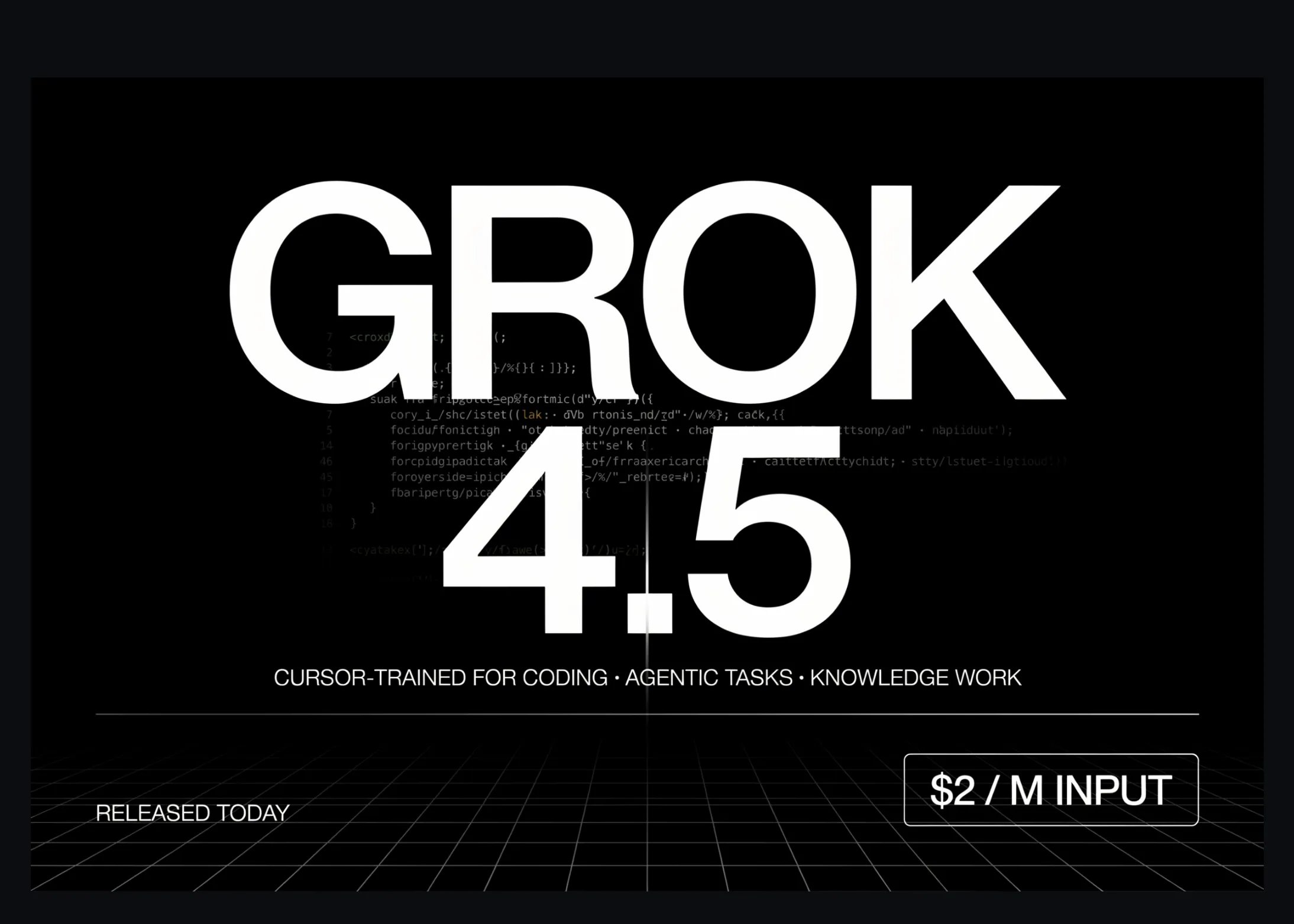
Cursor has launched Grok 4.5, a new AI model developed together with SpaceXAI and designed to go beyond coding into long-running agentic work across software, data, finance, legal tasks, and more.
Cursor’s New AI Step Goes Beyond Coding
Cursor has officially introduced Grok 4.5, a new AI model developed together with SpaceXAI. According to Cursor, this is its “most intelligent model” so far and the first one the company has built for more than software engineering.
Unlike previous Cursor models focused mainly on code generation and editing, Grok 4.5 is being positioned as a broader agentic model. Cursor says it can handle difficult, long-running tasks that require using tools creatively, including work in software engineering, data science, finance, legal tasks, and other computer-based workflows.
How Grok 4.5 Was Trained
Cursor describes Grok 4.5 as a mixture-of-experts model trained jointly with SpaceXAI. The training process included trillions of tokens of Cursor data, capturing developer interactions with codebases, software tools, and agent workflows.
The company says this approach helps the model understand not only existing software, but also the way developers actually work with AI agents inside real environments. Cursor also notes that Grok 4.5 was trained with a broader data mix than Composer 2.5, including STEM tasks, research papers, and knowledge-work material.
Built for Long-Running Agentic Tasks
One of the biggest focuses of Grok 4.5 is reinforcement learning on difficult, realistic problems. Cursor says the model was trained in environments that require investigation, tool use, mistake recovery, and result verification.
That matters because modern AI coding tools are moving away from simple autocomplete and toward agents that can plan, execute, test, and iterate over longer sessions. Cursor is clearly positioning Grok 4.5 as a model for that next phase: not just answering prompts, but working through complex tasks inside the developer’s workflow.
Availability and Pricing
Grok 4.5 is available now in Cursor across desktop, web, iOS, CLI, and SDK. Cursor says individual and team plans include significant usage of the model, with double usage during the first week.
The base model is priced at $2 per million input tokens and $6 per million output tokens. Cursor also lists a fast variant priced at $4 per million input tokens and $18 per million output tokens.
What Happens to Composer 2.5?
Cursor says Grok 4.5 does not replace Composer 2.5. Instead, the company describes both models as different “weight classes.” Composer 2.5 will remain available, and Cursor says it plans to continue releasing models of that size in the future.
That gives users a choice between a heavier model built for more complex, long-running work and a smaller model aimed at more focused coding tasks.
Why This Matters
The launch of Grok 4.5 shows how quickly AI coding tools are evolving. Cursor is no longer only competing as an AI code editor; it is moving toward becoming a full agentic work platform.
For developers, the most interesting part will be whether Grok 4.5 can reliably handle real-world projects: navigating codebases, making changes, testing results, and recovering from mistakes without constant supervision. If it delivers on that promise, Cursor could become even more central to how software teams build and maintain products.
At the same time, the model’s broader training suggests Cursor wants to expand beyond programming. Grok 4.5 is being pitched as a tool for any complex task that happens on a computer, which could put Cursor in direct competition with a wider range of AI assistants and workplace automation tools.
Bottom Line
Grok 4.5 is one of Cursor’s biggest AI launches so far. It brings together Cursor’s developer workflow data with SpaceXAI’s model development, aiming to create an AI system that can handle deeper, longer, and more complex tasks than traditional coding assistants.
For now, the key question is simple: can Grok 4.5 turn agentic AI from a promising demo into a reliable daily tool for developers and knowledge workers?